Milwaukee Swinging Big in Free Agency: Will It Pay Off?

The Milwaukee Bucks are just a few years removed from an NBA championship, as they won it all in 2021. However, the organization is not in an easy position, as their star player, Giannis Antetokounmpo, wants to ensure he plays with a competitive team. General Manager Jon Horst and his front office, so far in free agency, have made some intriguing moves that they hope will contribute alongside Giannis in competing for an NBA Championship.

Horst began free agency by re-signing five players from the 2024-2025 Bucks team that finished 48-34, which was good enough for the 5th seed in the Eastern Conference. Those five players are Kevin Porter Jr. (2-year deal), Bobby Portis (3-year extension), Taurean Prince (2-year deal), Jericho Sims (2-year deal), and Gary Trent Jr.(2-year deal). The most notable players brought back were Bobby Portis, Gary Trent Jr., and Kevin Porter Jr. Trent played a crucial role for the Bucks in the postseason when they matched up against the Indiana Pacers. In Game 3, he scored 37 points, and in Game 5, he scored 33 points. Portis is the longest-tenured Buck out of the list and was on the championship team in 2021. Portis can stretch the floor as a power forward and provides consistent scoring for this Bucks offense. Porter Jr., for now, is the starting point guard for this Bucks team (we’ll explain why later), so his ball-handling and shot creation are needed, whether Horst brings in any other guards or not. Prince and Sims should both be good contributors to the rotation and provide some depth for next year’s squad. Despite bringing back five players, this Bucks team still lost quite a bit of talent from the rotation.

Next year’s team will be without Pat Connaughton, Damian Lillard, and Brook Lopez. Let’s start by getting the elephant out of the room by talking about the stunning move of releasing Damian Lillard. Many fans, when they heard about the news, were confused and wondered why. The explanation lies in the fact that the Bucks wanted to spread out Lillard’s contract over more years in order to create more cap space, so they could sign more free agents. Hence, by cutting Lillard, instead of paying him around $56 million for the next two years, they now only pay him $22 million but for 4 years. This strategic contract decision is very similar to what many NFL teams do nowadays with “void years”. These years essentially allow NFL teams to load up on talent and absorb the cap hit years down the line, when the salary cap increases due to higher league revenue (this strategy allowed the Philadelphia Eagles to field so much talent this year, despite the sheer number of players not on rookie deals). From an organizational perspective, it’s a genius move for the Bucks if the cap goes up; however, it’s unclear if their star player, Giannis Antetokounmpo, was approving of this decision. The next impactful player the Bucks lost was Brook Lopez. I think most Bucks fans were actually more sentimental about this departure than the Lillard decision. Lopez was a core player on that championship team, as his three-point shooting and defensive ability made him a mismatch for any team to face. Lopez signed a 2-year, $18 million deal with the Los Angeles Clippers. While Bucks fans have fond memories of him in a Bucks uniform, he is 37 years old, and Father Time is slowly creeping in the rearview mirror. The last player that will not return is shooting guard Pat Connaughton. The Bucks sent him and two of their own second-round picks to the Charlotte Hornets for Vasilije Micić. Connaughton was entering the final year of his contract by picking up his $9 million player option. Given the Bucks’ limited salary cap flexibility, it made sense to trade him, as the prior season he had played the fewest minutes since joining Milwaukee. Similar to Lopez, Pat was also a rotational player for that 2021 championship team, which makes Antetokounmpo and Portis the last active players that were on that 2021 championship team. A key sign signaling to fans and Eastern Conference teams that Jon Horst and his front office are willing to make changes in order to get back to the NBA Finals.

This urgency to compete has forced the Bucks to be active in free agency, the trade market, and the NBA Draft. Using their 2nd-round pick, the Milwaukee Bucks selected Bogoljub Marković, a center from Serbia. Marković is going to be a project player, but he does have great inside and outside scoring that could translate down the line. Additionally, they signed undrafted free agent Mark Sears. Sears, who started his career at Ohio University, transferred to Alabama and developed a reputation for his great shooting and playmaking ability at the point guard position. All of these rookies won’t be significant contributors next year, but in a couple years, they could find time in the rotation. To make up for it, the Bucks acquired players via trade and free agency that can certainly make an impact immediately.

The Bucks used some of the Damian Lillard money that they saved from cutting him to swipe away Myles Turner from the rival Pacers. Turner is a stretch-four big and has great offensive ability as a center. Defensively, he’s not as talented as Lopez, but offensively, he is the more well-rounded player. The Bucks also acquired Vasilije Micić from the Hornets in the Connaughton trade mentioned above. Micić is a talented playmaker at the guard position and might see limited minutes for the Bucks. The last player that the Bucks signed was veteran shooting guard Gary Harris. Harris is known for his three-point ability and should provide some depth for a backcourt that just lost Damian Lillard.

The 2025 offseason has provided a lot of turnover for this Bucks team, and there still is time for this team to add to their roster. It also must be noted that the Hawks have the right to swap picks with the Milwaukee Bucks. Therefore, it isn’t smart for the Bucks to retool the roster and shoot for the 10th or 9th seed in the Eastern Conference. Given all of the nuance, I applaud the front office for making changes that have the chance to lead them in the right direction. Yet, just like every sport, time will tell if these moves will be vindicated.

Issac Okoro Gone, but Lonzo Ball Gained in Cleveland Cavaliers-Chicago Bulls Trade

Cleveland – With the NBA offseason in full swing, we will begin seeing fan favorites come and go. While there have been many rumors of who we will see return to our beloved Cavaliers in this upcoming 2025-26 season, one of these rumors of Issac Okoro being traded has come true. The five year veteran with the Cavs was a forward guard who has been a big part of the team, when he was not dealing with unfortunate injuries. Okoro played 55 games this past 2024-25 regular season, with an average of 6.1 points, 2.4 rebounds, and 1.2 assists. While his offense may not be impressive to some, he certainly shined in his defense. 

Fans were shocked by the news as Issac Okoro is a familiar face who had been with the team for years, so it is never fun news to hear someone who has been loyal to you leave. But, with that being said, it is intriguing to see what Lonzo Ball may bring to the table, as well as the big personalities his brother, father, and himself have. The public, who knows the Ball family, knows they are a wild bunch. 

As mentioned, in the trade, Cleveland gained a familiar name of Lonzo Ball. Ball has 6 NBA seasons under his belt, playing for a few different teams. He has spent time with the Los Angeles Lakers, New Orleans Pelicans, and Chicago Bulls. He did unfortunately miss the 2022-23 and 2023-24 seasons due to injuries. In his 2024-25 season, Lonzo played 35 games and averaged 7.6 points, 3.4 rebounds, and 3.3 assists. 

All in all, once the 2025-26 season starts, all fans truly want is a healthy and winning team. After this past run for the NBA Championship was cut short in the Eastern Conference round to the Indiana Pacers, Cavs fans were yearning for more and are optimistic to have another great season. 

Durant’s Options Are Limited, but He Can Still Win Another Ring

Cleveland, OH – It’s been over seven years since Kevin Durant last won an NBA Championship. Several factors have contributed to this drought, but his time in Phoenix has been particularly stalled by the team’s heavy financial commitment to just three players. Kevin Durant, Bradley Beal, and Devin Booker account for nearly 70% of the Suns’ total salary cap. This wouldn’t be an issue if the roster gelled and played cohesive basketball. Unfortunately, the Suns haven’t meshed, and they can’t adjust due to the large salaries and Bradley Beal’s no-trade clause. With only one year left on Durant’s contract and at age 36, it’s likely he’ll be traded to a championship contender to finish his career.

Like the Cleveland Cavaliers, the Suns are stuck in the second apron, with a total cap of $228,464,502, about $26 million over the second-apron threshold. The rules for teams in the second apron trying to pull off a trade are: they can’t trade first-round picks seven years out, can’t do sign-and-trades, can’t send cash in deals, and must match salaries to move players. Ironically, these rules were designed to prevent superteams like the 2017-2019 Golden State Warriors, who once had a starting five of Stephen Curry, Klay Thompson, Draymond Green, DeMarcus Cousins, and, yes, Kevin Durant. In a way, Durant is navigating rules inspired by his own move from Oklahoma City to Golden State, which many fans called a “superteam.”

Before I list two possible trades, I want to note how variable Durant’s trade value is. On one hand, he’s a 15-time All-Star, two-time NBA champion, and two-time Finals MVP on two of the greatest teams in NBA history. On the other hand, at 36, he’s at an age where injuries can become a concern. Plus, the second apron limits Phoenix’s trade options. Ultimately, Durant’s trade value hinges on whether a front office prioritizes short-term wins over long-term risks. With that in mind, let’s look at two potential trades involving teams rumored to be in the mix.

As with the Cavs article I wrote last week, I’ll start with a trade proposed by NBA insiders Chris Herring, Zach Kram, Dave McMenamin, Kevin Pelton, and André Snellings. This deal sends Kevin Durant to the Houston Rockets. In return, the Suns receive Dillon Brooks, Reed Sheppard, Cam Whitmore, Jock Landale, the No. 10 pick in 2025, and a 2027 first-round pick (via Phoenix). The Suns would get two former first-round picks, Sheppard and Whitmore, who saw limited minutes this year due to Houston’s deep roster. Whitmore has shown flashes of potential, and Sheppard, the No. 3 overall pick in the 2024 NBA Draft, displayed elite three-point shooting and great patience as a guard at Kentucky. Brooks brings toughness and three-and-D versatility to a Phoenix team that needs it, while Landale adds a solid veteran presence. The biggest asset for Phoenix is regaining their 2027 first-round pick, which offers flexibility if they choose to retool which might require them to suffer in the win column for a couple of years. For Houston, this trade addresses their offensive struggles after a first-round playoff exit to Golden State. Durant, with his size, shooting, handles, and finishing ability, is one of the toughest players to guard in the league. Houston also sheds players who don’t fit their rotation. I like this trade for both sides, but I do think Phoenix might want one extra pick in this trade.

The next trade is one I came up with, involves the Miami Heat and Phoenix Suns. The Suns will trade Kevin Durant to Miami, and in return, they will receive Andrew Wiggins, Duncan Robinson, Haywood Highsmith, a 2027 Miami first-round pick swap, a 2029 Miami Heat unprotected first-round pick, and a 2030 unprotected first-round pick from Miami. Miami gets a star player to pair with their other two stars, Bam Adebayo and Tyler Herro. For Phoenix, they get a couple of wings who can shoot and play some defense. More importantly, this trade gives them two first-round draft picks starting the year Kevin Durant turns 40 years old. This is a trade for Phoenix to make if they want to retool this team and start a rebuild. As for Miami, they should do this if their mindset is to go all-in since the East looks wide open next year. Overall, I don’t think this trade gets done, but if the Houston deal falls apart, there aren’t many other teams that would make sense for KD.

Kevin Durant’s legacy is complex when fans debate his all-time ranking. However, if he pushes Phoenix to trade him to one of these destinations, he could get that coveted ring that isn’t tainted with discourse on its merit.

The Second Apron Is Brutal, but the Cavs Can Still Improve

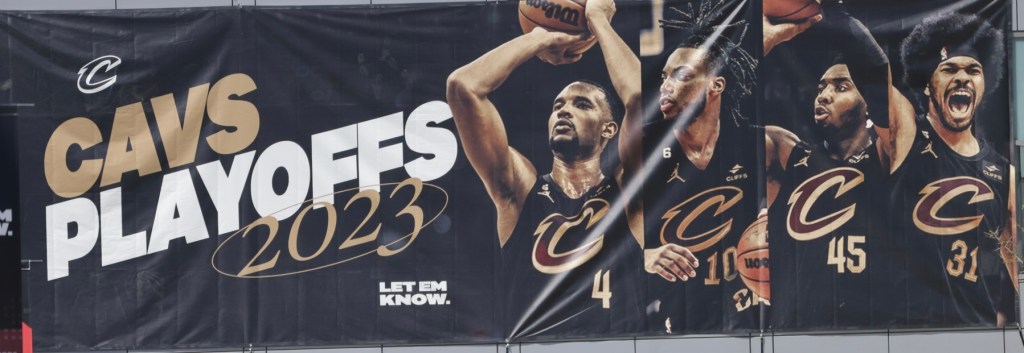
Employees of Brilliant Electric Sign Company work on the large banner hanging on the walkway between the garage and Rocket Mortgage FieldHouse. Cleveland Cavaliers playoff banners have been popping up this week as the Cavs prepare for their first round NBA playoff series starting on Saturday, April 15, 2023, against the New York Knicks.. David Petkiewicz, cleveland.com

Cleveland, OH- When the buzzer sounded to mark the end of game 5 of the 2025 Eastern Conference Semifinals, it was a somber moment, to say the least, for Cavs fans. A 60 plus win season, coupled with the third best net rating of the NBA, left a lot to be desired. Once again, bringing to the table another offseason of mock trades due to a postseason disappointment. However, unlike most offseasons, this will be the most challenging trade market for Cavs GM Koby Altman to navigate, as the Cavs are over the 2nd apron.

The threshold for this apron is $207.8 million dollars, and the Cavs payroll is currently $220.7 million, according to Spotrac. This apron was specifically set to stop teams like the Cavs from spending big on 3 or 4 players and then filling out the rest of the roster with a mid-level exception player and vets who were looking to take a pay cut in order to win a ring. This new rule stops teams constructing similar rotations through rules like not being able to trade a first round pick seven years into the future, no sign-and-trades, not being able to send cash in trades, and finally needing to match salaries in order to trade players. There are a few more restrictions, but the rules outlined above are the biggest impediments when it comes to the Cavs being able to improve their team via trades. So, with the elephant out of the room, let’s look at two Cavs trades.

The first trade is probably the most well known, and originated from Cleveland.com Cavs writer Chris Fedor. Fedor suggested that the Cavs could send All-Star Point Guard Darius Garland to the Orlando Magic in return for two former first round picks in Point Guard Jalen Suggs and forward Tristan da Silva. As for the Magic, I would think they would do this trade, since the team noticeably lacked offensive production, so getting Garland would fix that. I don’t think the Cavaliers would make this trade, but they should strongly consider it. Suggs brings elite defensive skills, evidenced by his All-NBA Defensive Second Team honor, while da Silva, despite limited production in his rookie season, was a standout shooter at Colorado. The Cavs could benefit greatly by adding a great defender and some three-point shooting.

The next trade originates from myself and involves the Cavs and the Lakers. The Cavs would trade Jarrett Allen and Isaac Okoro to the Los Angeles Lakers and in return receive Rui Hachimura, Dorian Finney-Smith, a 2028 Los Angeles unprotected 1st round pick, and a 2030 Los Angeles Lakers swap(best with the Cavs) first round pick. The Lakers are in desperate need of a center, and Okoro could fill in the void left by trading Finney-Smith. As for the Cavs, they pick up Finney-Smith, a three-and-D wing that is capable of starting, and they pick up Hachimura, who is an efficient scoring 6 ‘8 wing. Also, this trade would move the Cavs out of the second apron to the much more favorable 1st apron. Out of all trades I’ve seen mocked to the Cavs, I believe this is the one where both teams have a chance of saying yes(since most mock trades usually have the fans’ home team overwhelmingly winning the trade).

If the Cavs want to go far in the playoffs, then they have to stay healthy (something that hasn’t gone their way), but they also should listen to trade calls that could potentially stop the early playoff exits.